A Republican state senator in Indiana announced Friday that he will oppose the state’s ongoing redistricting proposal. His decision, which could ultimately influence the partisan balance of the U.S. House of Representatives in 2026, comes in response to comments made by former President Donald Trump about Minnesota Governor Tim Walz.
Late on Thanksgiving night, Trump published a forceful post on X outlining his intention to halt all immigration—both legal and illegal—from what he described as “third-world countries.” He said the plan would also apply to individuals who, in his view, hold negative attitudes toward the United States.
Midway through his message, Trump shifted to criticism of political leaders in Minnesota. He targeted both Governor Walz and U.S. Representative Ilhan Omar, referencing long-standing controversies related to the state’s Somali-American population.
In the post, Trump used disparaging language to describe Walz and Omar. His remarks sparked immediate reaction across political circles, including inside the Republican Party.
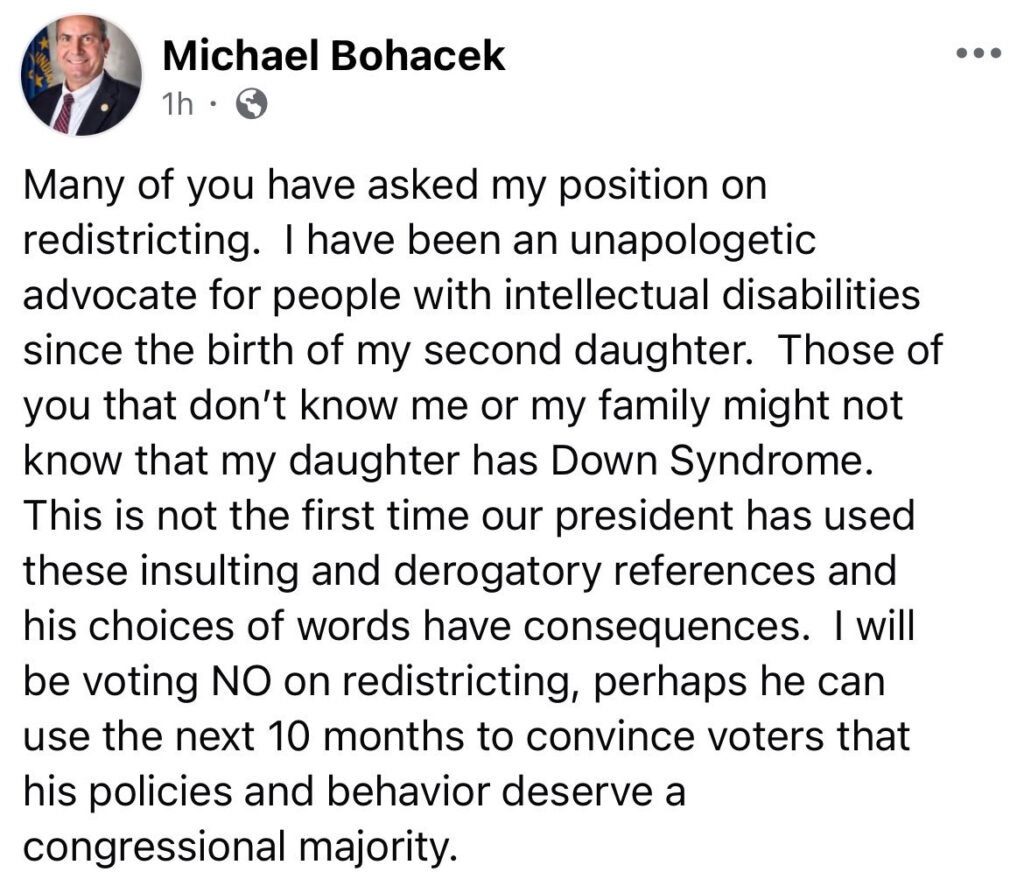
Not long after Trump’s post circulated, Indiana State Senator Michael Bohacek announced via Facebook that he would not support the Trump-aligned redistricting map. The proposal is expected by GOP strategists to potentially yield two additional congressional seats for Republicans in 2026.
In his announcement, Bohacek framed his decision as deeply personal. He explained that he has long advocated for individuals with intellectual disabilities, referencing his daughter’s Down syndrome diagnosis as central to his perspective.
He argued that Trump’s use of certain terms was insulting and harmful. According to Bohacek, the president’s rhetoric carries consequences, affecting both the public and those working within politics.
Because of this, Bohacek stated he would vote against the redistricting plan. He added that Trump would have “the next 10 months” to demonstrate to voters that his leadership merits a Republican congressional majority.
His post triggered strong backlash from segments of the Republican base. Many within the party, citing months of polling, have expressed unwavering support for Trump and viewed Bohacek’s stance as disloyal or self-serving.
One conservative commentator, Eric Daugherty of Florida’s Voice, condemned Bohacek’s decision as immature and harmful to the party’s broader objectives. Others suggested he should face a primary challenge.
Several critics also resurfaced details of Bohacek’s previous legal trouble. They referenced an incident in which he was found driving with a blood alcohol concentration more than three times the legal limit.
In that incident, Bohacek was reportedly observed drinking from an open container and stumbling near his vehicle before driving away. Police later stopped him for speeding, and a hospital test showed a BAC of 0.28%, well above Indiana’s legal threshold.
Because the state constitution grants lawmakers temporary immunity from arrest during legislative sessions—except in cases involving felonies, treason, or breaches of the peace—Bohacek was not taken into custody at the scene.
Prosecutors filed formal operating-while-intoxicated charges after the session ended. Bohacek later accepted a plea agreement, resulting in a misdemeanor conviction without widely released details regarding sentencing.
Now, his refusal to support the redistricting map introduces uncertainty into Indiana’s role in shaping the next Congress. With Democrats in several blue states pursuing aggressive gerrymanders of their own, GOP strategists have viewed Indiana’s map as part of a broader attempt to counter perceived disadvantages from census undercounts in Republican-leaning states.
As states such as Texas, Missouri, and North Carolina advance their own redistricting revisions, Indiana’s internal dispute adds another layer of complexity to the national contest for House control in 2026.