

Former U.S. Sen. Ben Nighthorse Campbell, a towering figure in Colorado and national politics known for his independence and dramatic party switch, died Tuesday at the age of 92, according to his family. Campbell passed away of natural causes while surrounded by loved ones, his daughter Shanan Campbell said. He is survived by his wife, Linda, their children Shanan and Colin, and four grandchildren, leaving behind a legacy that spanned politics, military service, athletics, and the arts.
[read more]
Campbell served in the U.S. Senate from 1993 until his retirement in 2005, a tenure marked by one of the most startling political moves of the era when he left the Democratic Party to become a Republican in 1995. The switch shocked Washington and angered Democratic leadership, but it reinforced Campbell’s reputation as a lawmaker guided more by personal conviction than party loyalty. Before his time in the Senate, he served in both the U.S. House of Representatives and the Colorado House, consistently cultivating an image as an independent-minded politician unwilling to follow rigid ideological lines.
Widely recognized for his advocacy on Native American issues, Campbell was a member of the Northern Cheyenne tribe and often spoke about the historical injustices faced by Indigenous peoples. He said his ancestors were among those killed in the 1864 Sand Creek Massacre in southern Colorado, an event that profoundly shaped his worldview. Later in his career, he helped sponsor legislation to elevate the Great Sand Dunes National Monument—near the site of the massacre—to national park status. His policy positions often blended support for Native American rights, children’s rights, organized labor, and fiscal conservatism, creating a political profile that defied easy categorization.
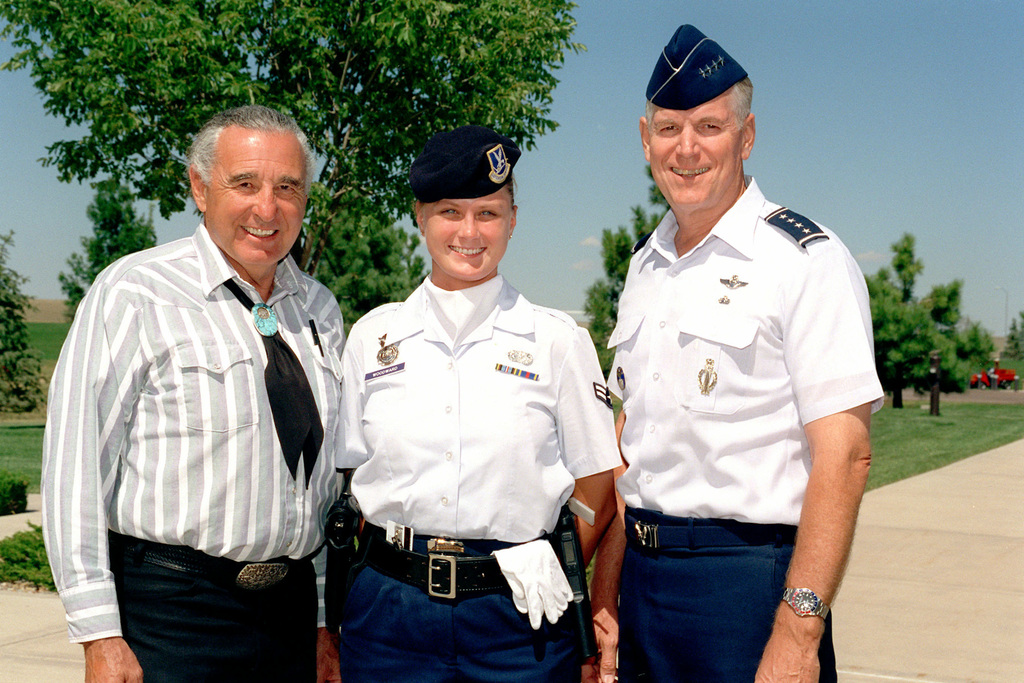
(2004) US Senator Ben “Nighthorse” Campbell (Left), Republican from Colorado, and US Air Force General Richard B. Myers (Right), Commander in Chief, North American Aerospace Defense Command, Peterson Air Force Base, CO, pose with USAF Senior Airman Stacy Woodward of the 50th Security Forces Squadron, Schriever AFB, CO.
Outside of politics, Campbell was equally accomplished. He was an internationally respected master jeweler, with his work displayed at the Smithsonian Institution’s National Museum of the American Indian. Colorado Sen. John Hickenlooper praised Campbell’s craftsmanship and kindness, noting that his reputation extended far beyond Colorado. Following his death, Gov. Jared Polis ordered flags lowered to half-staff on the day of Campbell’s service, honoring what he called Campbell’s lasting contributions to the state and the nation.
Born on April 13, 1933, in Auburn, California, Campbell served in the U.S. Air Force during the Korean War before embarking on a remarkably varied life. He earned a bachelor’s degree from San Jose State University, studied at Meiji University in Tokyo, captained the U.S. judo team at the 1964 Olympics, and won a gold medal at the Pan American Games. Over the years, he also worked as a deputy sheriff, coached and taught judo, ran a dojo, taught high school classes, rode motorcycles competitively, ranched cattle, and was inducted into the AMA Motorcycle Hall of Fame. His life’s breadth and individuality mirrored the unconventional path he forged in American public life.[/read]