

Hundreds of frustrated employees within the Minnesota Department of Human Services (DHS) are openly criticizing Governor Tim Walz, accusing his administration of allowing a large-scale fraud scheme to grow unchecked and punishing those who attempted to expose it.The scandal centers on the Feeding Our Future case, in which more than $1 billion in federal pandemic funds intended for feeding children were diverted by scammers. It is now considered the largest COVID-era fraud scheme in the United States.
[read more]
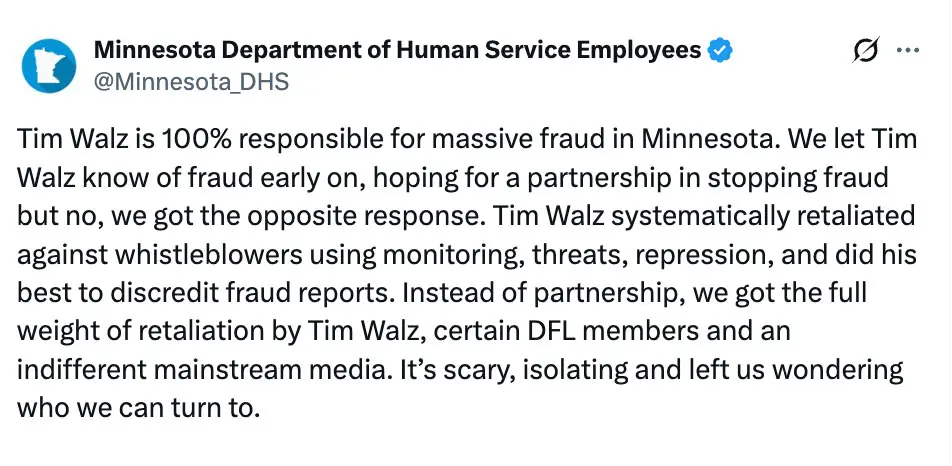
In a statement posted Saturday, an X account representing more than 480 DHS employees claimed that Walz failed to act when concerns were brought to him. The post argued that the governor bore full responsibility for the extent of the fraud.
The employees said they had hoped state leadership would support them when they raised alarms. Instead, they claimed they were met with resistance and retaliation rather than collaboration.
Their message coincides with new developments in the federal investigation. The U.S. Department of Justice recently secured its 78th prosecution tied to the scheme, with at least 59 individuals convicted to date.
For years, investigators say, bad actors exploited Minnesota’s extensive social-services system. By forming shell organizations, they submitted invoices for meals and services that prosecutors argue never existed.
Feeding Our Future, founded in 2016 and ostensibly focused on feeding schoolchildren, partnered with numerous local groups claiming to provide meals to tens of thousands of low-income students. The nonprofit collapsed in 2022 as investigators uncovered widespread misuse of funds.
Federal prosecutors reported that much of the money was spent on luxury goods, international real estate, high-end vehicles, and extravagant personal purchases rather than feeding children.
Authorities also discovered that additional organizations connected to Minnesota’s safety-net programs had engaged in similar fraud schemes. Prosecutors say several of the networks involved were tied to members of Minnesota’s roughly 80,000-person Somali community.
The DHS employees’ statement asserted that staff repeatedly witnessed fraudulent activity firsthand but were discouraged from speaking out. They claimed leadership reassigned whistleblowers, ignored warnings, and sought to avoid any action that might create political or cultural backlash.
According to the workers, concerns about appearing discriminatory led state officials to overlook or downplay clear signs of corruption within certain programs and organizations.
Federal charges began to emerge publicly in 2022. Once investigators started analyzing records, they found that the scale of the fraud was far larger than initially suspected.
One homelessness-related program experienced explosive growth, expanding from $2.6 million in 2021 to $104 million the following year. According to reporting from the New York Times, most of that increase was attributed to fraudulent activity.
The ballooning fraud cases have prompted fierce political criticism. Members of Minnesota’s congressional delegation have argued that the state’s oversight failures allowed the schemes to flourish.
House Majority Whip Tom Emmer condemned the Walz administration in a statement to The Post. He argued that Minnesota had become overwhelmed by fraud and accused state leaders of being unwilling or unable to manage the crisis.
Emmer said the situation represented a betrayal of Minnesota taxpayers and suggested that the administration’s inaction enabled the state’s growing corruption problems.
 [/read]